Print
Print
 PDF
PDF
It is expected that India’s Prime Minister Narendra Modi will officially open the new container terminal built by Singapore’s PSA International group at Jawaharlal Nehru Port Trust (JNPT) on February 18th this year. The first container services have already started using the Bharat Mumbai Container Terminals (BMCT) facility, however, auguring well for its future.
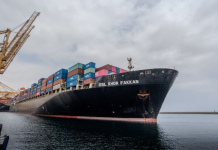
The terminal recently received its first direct European service call when Hapag Lloyd’s 10,114 teu Express Rome, which operates within the Indian Ocean Service (IOS), berthed in early February. Speaking at the occasion, Dheeraj Bhatia, managing director of Hapag-Lloyd India, praised the initiative which set up JNPT’s fourth container terminal. Mr Bhatia commented, “The start of BMCT is a great milestone in the Indian port infrastructure space. The addition of this new capacity will help in increasing efficiency and offer improved turnaround times.”
The start of Hapag-Lloyd services followed the maiden call at the terminal of CMA CGM’s 3426 teu Centaurus, which is part of the Swahili Express Service (SWAX). Direct rail services connecting JNPT with Northern Indian have also started to run from the terminal and other regular liner shipping service calls are expected to be announced in the next few weeks.
The terminal currently has 1000 m of berth, with 16.5m draft alongside, and is equipped with six super post-panamax cranes, allowing BMCT to accommodate some of the largest container vessels afloat. Three more quay cranes are due to arrive in July 2018 and a further three in 2019.
Construction of phase 2 of BMCT, which will add another 1000m of quay, is expected to start next year. When this work is completed it will take the facility to a total capacity of 4.8 million teu a year, making it India’s largest container terminal.
The opening of the new terminal is a further boost to JN Port, which goes from strength to strength. In January this year the west coast gateway port handled 418,000 teu, its highest ever monthly figure, and 13% more than it recorded in January 2017.